US vs. Latin American Equities: A Valuation Gap

US vs. Latin American Equities: A Valuation Gap

Is Now the Time to Invest in Latin American Stocks?

A Look at the US vs. Latin America and Mexico’s Market Potential

At Financial Liberties, we’re always on the lookout for investment opportunities that balance risk and reward. Recent market trends have highlighted a stark contrast between US and Latin American equities, with US stock prices hovering at historically high valuations while Latin American markets, including Mexico, appear undervalued. Let’s break down this dynamic and explore whether now is a good time to invest in Latin American stocks, with a focus on Mexico’s market.

US vs. Latin American Equities: A Valuation Gap

The US stock market, as tracked by indices like the Morningstar US Market Index, has been trading at elevated price-to-earnings (P/E) ratios, reflecting investor confidence but also raising concerns about overvaluation. In contrast, Latin American equities, represented by indices like the Morningstar Emerging Markets Americas Index, are trading at lower valuations. As of June 2025, the P/E ratio for Latin American stocks was approximately 10.08, compared to a 5-year average of 9.16, suggesting they remain fairly valued relative to their historical norms.

This valuation gap stems from several factors. In 2024, Latin America was the world’s worst-performing region for equities, dragged down by political risks in Brazil and Mexico, inflation-driven interest rate hikes, and perceptions of government interference in key companies like Brazil’s Petrobras. Meanwhile, the US market has been buoyed by strong corporate earnings and tech-driven growth. However, 2025 has seen a reversal, with Latin American stocks surging over 25% in US dollar terms by mid-May, outpacing the US market, which has barely stayed afloat.

Why Latin American Stocks Look Attractive

Despite the recent rally, Latin American equities still offer compelling opportunities. Morningstar’s Multi-Asset Research models project 10-year annualized returns of nearly 10% for Brazilian equities and 7% for Mexican equities in USD terms, outstripping expectations for US stocks.

Several factors support this optimism:

  1. Undervaluation and Growth Potential: Latin American stocks, particularly in Brazil and Mexico, are trading at discounts compared to their historical averages and global peers. Brazil’s market, for instance, trades at a 23% discount to its historical P/E, making it cheaper than markets like China or India.
  2. Macro Tailwinds: The Brazilian real and Mexican peso have strengthened against the US dollar in 2025, boosting returns for US investors. Strong corporate earnings and supportive structural factors, like Brazil’s hydrocarbon production and Mexico’s nearshoring trend, further enhance the region’s appeal.
  3. Foreign Investment Flows: Global inflows into Latin American equity funds reached $2.9 billion year-to-date in 2025, a sharp reversal from $7 billion in outflows in 2024. Brazil’s B3 exchange saw R$27 billion in foreign inflows, particularly in utilities, financials, and consumer discretionary sectors.

Mexico’s Stock Market:

A Standout in Latin AmericaMexico, which accounts for roughly 30% of the Morningstar Emerging Markets Americas Index, deserves special attention. Despite political turbulence following Claudia Sheinbaum’s 2024 election victory and concerns over US trade policies under President Trump, Mexico’s market has shown resilience. The derating in 2024, driven by fears of institutional decay and potential US tariffs, has left Mexican stocks trading at decade-low valuations, presenting a potential buying opportunity.

Mexico’s economy is projected to grow at a steady 2.1% annually from 2025 to 2030, fueled by nearshoring as global companies shift manufacturing from China to Mexico. Companies like Grupo Aeroportuario (ASR), with a low forward P/E of 13.9x and strong EBITDA growth, and Gruma, which earns 72% of its revenue outside Mexico, are well-positioned to benefit from this trend. Mexico’s manufacturing strength, particularly in automotive exports, and its role as a key US trade partner further bolster its long-term outlook.

However, risks remain. Political uncertainty, including potential judicial reforms and US trade tensions, could weigh on sentiment. The Mexican peso’s volatility and exposure to global trade disruptions also warrant caution.

Is Now a Good Time to Invest?

For investors seeking diversification and value, Latin American stocks, including Mexico’s, present a compelling case in 2025. The region’s low valuations, coupled with improving macro conditions and foreign investment inflows, suggest potential for outperformance over the US market, which faces headwinds from high valuations and trade war concerns. Mexico, in particular, offers unique opportunities due to its nearshoring-driven growth and undervalued stocks, though political and currency risks require careful monitoring.

Actionable Advice:

  • Diversified Approach: Consider broad-based Latin American ETFs, such as those tracking the MSCI Latin America Index, to mitigate country-specific risks. These funds allocate heavily to Brazil (57%) and Mexico (31%), providing balanced exposure.
  • Selective Stock Picks: For those comfortable with higher risk, individual stocks like MercadoLibre (MELI), Nu Holdings (NU), or Grupo Aeroportuario (ASR) offer growth potential at attractive valuations.
  • Risk Management: Given the region’s volatility, limit exposure to 5-10% of your portfolio and hedge currency risk if investing directly.

At Financial Liberties, we believe Latin American equities, particularly in Mexico, are worth a closer look for value-driven investors. While risks persist, the region’s growth prospects and undervaluation make it a potential bright spot in a cloudy global market. Always consult with a financial advisor to align investments with your goals and risk tolerance.

Disclaimer: Investing involves risks, and past performance is not a guarantee of future results. Always conduct thorough research or seek professional advice before investing.

If you enjoyed this blog, read the blog about The Benefits of Starting or Buying a Business in Mexico


If you would like to read more about Investing and Entrepreneurship in Mexico, join our Facebook group, which covers various topics of discussion.


We also offer consulting services if you would like to start your journey towards Financial Liberties in Mexico. You can see more about our consulting services on this page.  https://financialliberties.com/product/consulting/
Being Self Employed In Mexico, With Low Income Tax

Being Self Employed In Mexico, With Low Income Tax

Why Being Self-Employed Under RESICO in Mexico Is a Smart Choice Compared to the U.S. and Canada

If you’re considering self-employment or starting a small business, Mexico’s Régimen Simplificado de Confianza (RESICO) offers one of the most attractive tax environments in North America. Designed to support small business owners and independent workers, RESICO allows individuals earning up to 3.5 million pesos per year (approx. $200,000 USD) to pay income tax rates between just 1% and 2.5% on their gross income.
 

Tax Savings vs. U.S. and Canada

In contrast, self-employed individuals in the United States can pay up to 15.3% in self-employment tax (Social Security and Medicare) before even considering federal or state income taxes. In Canada, self-employed individuals not only face progressive federal and provincial income taxes, but also must pay the entire Canada Pension Plan (CPP) contribution, which can amount to over 10% of income.


Why RESICO Stands Out

  • Ultra-low income tax: Starting at 1%, capped at 2.5%, depending on income.
  • Simple compliance: No complex accounting or costly tax filing — RESICO uses monthly declarations based on actual payments received.
  • No annual return required (for many): If you’re within the RESICO thresholds and meet your monthly obligations, you may not even need to file an annual return.
  • Ideal for freelancers, consultants, small vendors, and digital nomads operating in Mexico.

Employment & Business Flexibility

In a world where remote work and entrepreneurial freedom are growing, RESICO offers a unique path to formalize your income and retain more of your earnings, without the heavy tax burden found in the U.S. or Canada. Whether you’re consulting, freelancing, running a local shop, or selling online, RESICO helps you stay legal, compliant, and financially efficient.

Bottom line: If you’re seeking independence and want to maximize your income, being self-employed under RESICO in Mexico is a tax-smart, low-hassle alternative that can outperform traditional employment models in North America.

If you enjoyed this blog, read the blog about The Benefits of Starting or Buying a Business in Mexico


If you would like to read more about Investing and Entrepreneurship in Mexico, join our Facebook group, which covers various topics of discussion.


We also offer consulting services if you would like to start your journey towards Financial Liberties in Mexico. You can see more about our consulting services on this page.  https://financialliberties.com/product/consulting/
Why Starting or Buying a Business in Mexico Is a Smart Move: Key Benefits and Data

Why Starting or Buying a Business in Mexico Is a Smart Move: Key Benefits and Data

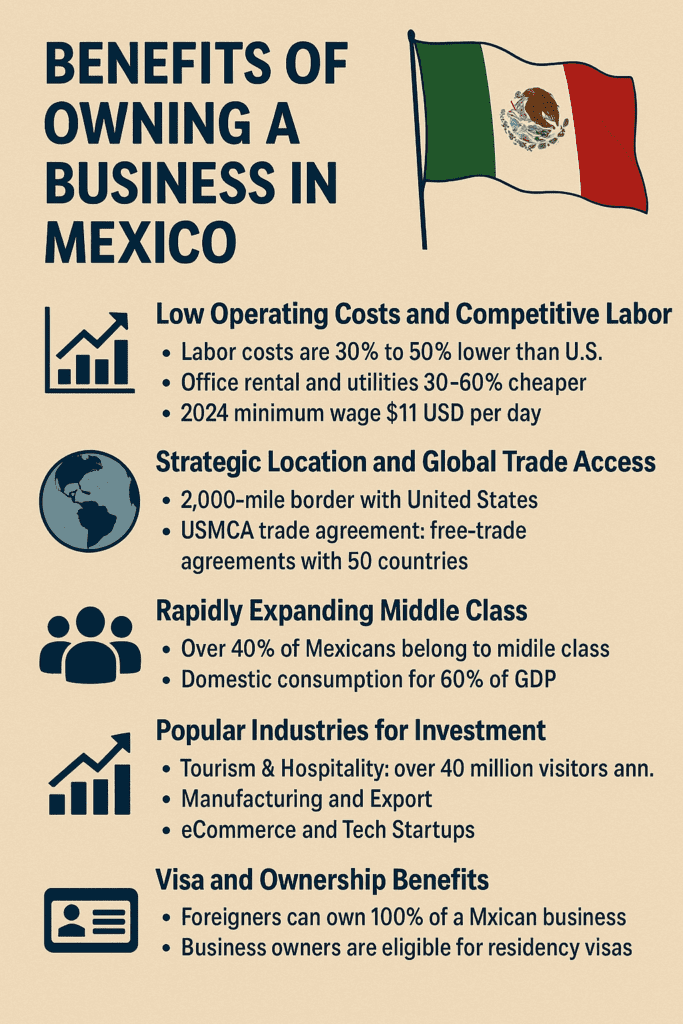
Mexico has emerged as a strategic hotspot for entrepreneurs and investors looking to buy or own businesses. With its proximity to the U.S., favorable trade agreements, low operating costs, and growing consumer market, Mexico offers both stability and high-growth potential. Here’s a data-backed overview of the benefits of owning a business in Mexico:


1. Low Operating Costs and Competitive Labor
Mexico offers a cost-effective business environment compared to many Western nations:
  • Labor costs are significantly lower than in the U.S.—about 30% to 50% less, depending on the sector.
  • Office rental and utility expenses are also 30-60% cheaper than in major U.S. cities.
  • The minimum wage in 2024 was approximately $11 USD per day, although skilled labor earns more, it’s still far more competitive than in developed economies.
2. Strategic Location and Global Trade Access
Mexico provides direct access to both North and South American markets:
  • It shares a 2,000-mile border with the United States, making logistics and distribution fast and affordable.
  • As part of the USMCA trade agreement (formerly NAFTA), businesses in Mexico benefit from duty-free exports to the U.S. and Canada.
  • Mexico also has free trade agreements with 50+ countries, giving it one of the largest trade networks globally.
3. Rapidly Expanding Middle Class
The Mexican middle class is growing and becoming a major force in domestic consumption:
  • According to the OECD, over 40% of Mexicans are now considered middle class.
  • Domestic consumption accounts for around 60% of GDP, creating strong demand for products and services in sectors like food, retail, health, and tech.
4. Popular Industries for Investment
Foreign and local buyers are particularly attracted to industries such as:
  • Tourism and Hospitality – Mexico is the 7th most visited country in the world, drawing over 40 million international tourists annually.
  • Manufacturing and Export – Especially in automotive, aerospace, electronics, and textiles.
  • eCommerce and Tech Startups – A growing fintech and startup scene is drawing global attention and VC funding.
5. Visa and Ownership Benefits
Foreigners can own 100% of a Mexican business, even as a non-resident (except for restricted zones near the coasts and borders which can be held via a trust).
  • Business owners are eligible for temporary or permanent residency visas.
  • Setting up an LLC (S. de R.L. de C.V.) in Mexico is relatively easy and can be done within a few weeks.
Conclusion
With its low costs, access to international markets, and expanding consumer base, buying or owning a business in Mexico offers a strategic opportunity for growth and diversification. Whether you’re looking for a retirement investment, a lifestyle business, or to expand your global footprint, Mexico is well-positioned to deliver strong returns.
I prompted Chat GPT for this article, but would love your comments and thoughts on starting or buying a business in Mexico. Feel free to share your experiences in running a business in Mexico.


Read about Mexico’s low-income tax of 1% – 2.5% for the self-employed.

If you would like to read more about Investing and Entrepreneurship in Mexico, join our Facebook group, which covers various topics of discussion.


We also offer consulting services if you would like to start your journey towards Financial Liberties in Mexico. You can see more about our consulting services on this page.  https://financialliberties.com/product/consulting/
The Future of Cryptocurrency: June 2024

The Future of Cryptocurrency: June 2024

As the world continues to grapple with economic uncertainties and shifting financial landscapes, the role of cryptocurrency is becoming more prominent. In recent months, we’ve seen significant developments that suggest a bright future for digital assets. Let’s delve into the current state of the market and explore what lies ahead.

Bitcoin’s Resurgence

Bitcoin has once again proven its resilience, bouncing back from its mid-2023 slump to reach new heights. The leading cryptocurrency recently surpassed the $70,000 mark, driven by renewed institutional interest and increasing mainstream acceptance. The question on everyone’s mind: Will Bitcoin continue its upward trajectory, or are we heading for another period of volatility?  If you seek the answer to this questions, we discuss this in our Newsletter based on fundamental and technical analysis.

Altcoins on the Rise

While Bitcoin grabs the headlines, it’s important not to overlook the impressive performance of various altcoins. Ethereum, with its groundbreaking shift to a proof-of-stake model, is setting new standards for blockchain technology. Meanwhile, lesser-known tokens like Solana and Cardano are gaining traction, offering unique solutions to scalability and transaction speed issues.  What about XRP and Ripple Labs, will this be the standard for transactions globally, or will the other platforms lead the way?

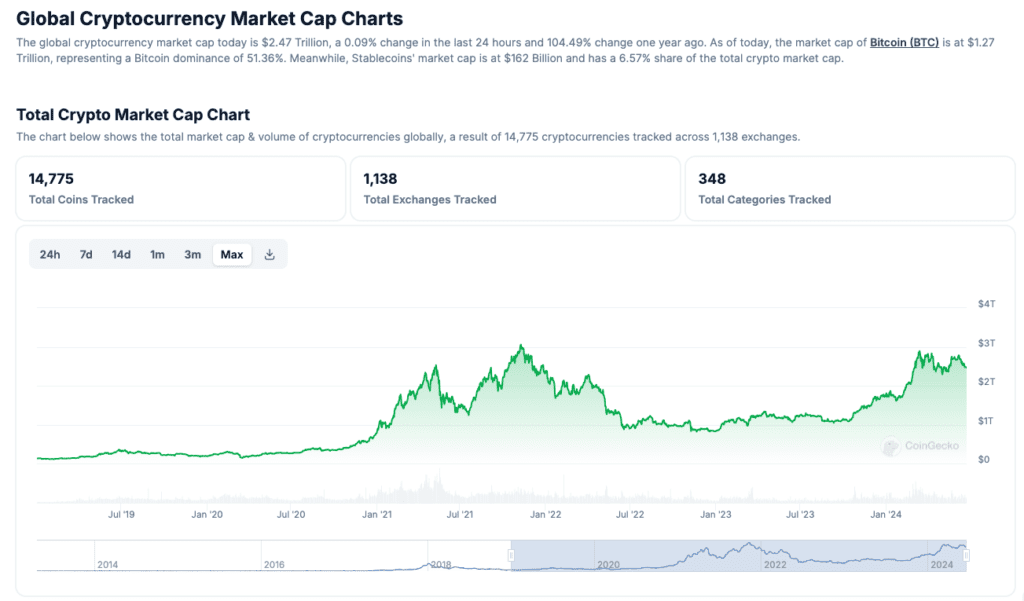
Crypto Market Cap, June 2024

From the chart below, we can see that the overall Market Cap has risen significantly in the past year, this could be a result of the recent introduction of BTC Exchange Traded Funds (ETFs) and the Bitcoin Having that took place in April 2024.  Has all the good news been factored into Bitcoin and could we see a market selloff going into the summer and fall of 2024, or will the overall market cap for Cryptos continue to rise?  Will the introduction of Ethereum ETFs lift the price of ETH and the overall market cap for Cryptos, or has that already been factored into the price and we will have stable prices moving forward?  


Regulatory Landscape

The regulatory environment remains a critical factor in the evolution of cryptocurrencies. Recent moves by governments around the world indicate a trend towards greater oversight and regulation. While this could initially slow down market growth, many believe that clear guidelines will ultimately legitimize and stabilize the industry. How will these regulations shape the future of crypto? Will we see more countries adopting crypto-friendly policies, or will crackdowns become more common?

The Role of Central Bank Digital Currencies (CBDCs)

Central banks are also entering the digital currency arena with the development of CBDCs. These government-backed digital currencies aim to combine the benefits of traditional fiat money with the advantages of digital transactions. Countries like China are leading the way, with the digital yuan already in circulation. The introduction of CBDCs raises important questions about the future of decentralized cryptocurrencies and their place in the global financial system.

Advantages of Investing in Cryptocurrencies

  1. High Growth Potential: Cryptocurrencies have shown significant growth over the past decade, with many investors seeing substantial returns. The innovation and adoption in the blockchain space continue to drive this potential.
  2. Diversification: Adding cryptocurrencies to your portfolio can provide diversification, as they often do not correlate directly with traditional asset classes like stocks and bonds.
  3. Inflation Hedge: Cryptocurrencies like Bitcoin are often viewed as a hedge against inflation, as their limited supply can protect against the devaluation of fiat currencies.
  4. Decentralization: The decentralized nature of cryptocurrencies offers an alternative to traditional banking and financial systems, reducing reliance on central authorities.

Disadvantages of Investing in Cryptocurrencies

  1. Volatility: Cryptocurrencies are known for their extreme price volatility, which can lead to significant losses in a short period. This volatility makes them a high-risk investment.
  2. Regulatory Uncertainty: The lack of consistent regulatory frameworks across different countries creates uncertainty. New regulations could impact the value and legality of certain cryptocurrencies.
  3. Security Risks: While blockchain technology is secure, the platforms and exchanges that deal with cryptocurrencies can be vulnerable to hacking and fraud, leading to potential losses.
  4. Market Manipulation: The relatively low market capitalization of many cryptocurrencies makes them susceptible to market manipulation, where prices can be artificially influenced by large holders or coordinated groups.

Investment Opportunities

For those looking to capitalize on the growing crypto market, now is the time to pay attention. Diversification remains key, with a balanced portfolio of Bitcoin, top-performing altcoins, and emerging tokens offering the best potential for long-term gains. Additionally, keeping an eye on regulatory changes and technological advancements will be crucial for making informed investment decisions.

Conclusion

The cryptocurrency market is evolving rapidly, and staying informed is more important than ever. As Bitcoin and other digital assets continue to mature, their role in the financial system will only grow. Whether you’re a seasoned investor or new to the world of crypto, understanding the trends and dynamics at play will help you navigate this exciting and unpredictable landscape.

Stay tuned for more updates and in-depth analysis in the Financial Liberties Newsletter. If you haven’t subscribed yet, don’t miss out on our special offer running until the end of July. We’re committed to providing you with the insights and information you need to stay ahead in the ever-changing world of finance.

Understanding Stablecoins: The Backbone of Crypto Stability

Understanding Stablecoins: The Backbone of Crypto Stability

In the ever-evolving world of cryptocurrency, stablecoins have emerged as a crucial component, bridging the gap between the volatility of digital currencies and the stability of traditional fiat money. This blog delves into what stablecoins are, the different types available, their uses, their value, and their potential future in finance and commerce.

What is a Stablecoin?

A stablecoin is a type of cryptocurrency designed to maintain a stable value relative to a specific asset or a basket of assets. Unlike traditional cryptocurrencies like Bitcoin or Ethereum, whose prices can be highly volatile, stablecoins aim to offer price stability. They achieve this by being pegged to more stable assets such as fiat currencies (e.g., USD, EUR), commodities (e.g., gold), or even other cryptocurrencies.

Types of Stablecoins

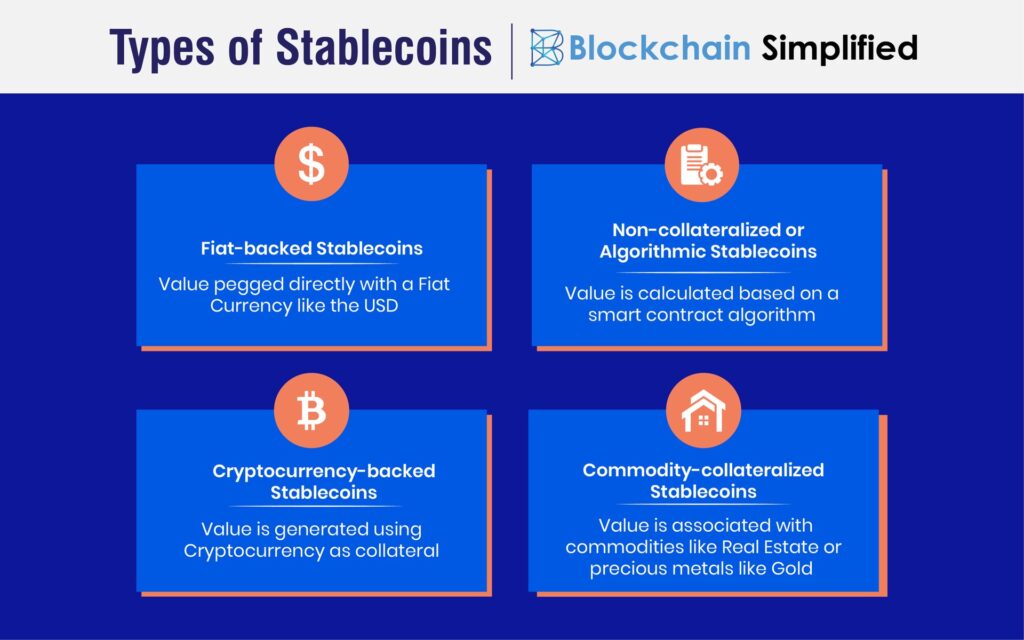
Stablecoins can be broadly categorized into four main types based on the mechanisms they use to maintain their stability:

  1. Fiat-Collateralized Stablecoins
    • These stablecoins are backed by a reserve of fiat currency. For every unit of stablecoin issued, an equivalent amount of fiat currency is held in reserve. Examples include Tether (USDT), USD Coin (USDC), and TrueUSD (TUSD).
  2. Crypto-Collateralized Stablecoins
    • These are backed by other cryptocurrencies. To account for the volatility of the backing cryptocurrency, these stablecoins are often over-collateralized. An example is DAI, which is backed by Ethereum and other cryptocurrencies.
  3. Commodity-Collateralized Stablecoins
    • These stablecoins are backed by physical assets like gold or real estate. One example is Paxos Gold (PAXG), which is backed by physical gold.
  4. Algorithmic Stablecoins
    • Unlike the other types, algorithmic stablecoins are not backed by any collateral. Instead, they use algorithms and smart contracts to control the supply of the stablecoin, aiming to keep its value stable. Examples include Ampleforth (AMPL) and TerraUSD (UST).

Uses of Stablecoins

Stablecoins have a variety of uses in the cryptocurrency ecosystem and beyond:

  1. Trading and Hedging
    • Stablecoins provide a safe haven for traders during periods of high volatility. They allow traders to quickly move in and out of volatile assets without converting to fiat currency, saving time and reducing transaction fees.
  2. Remittances and Payments
    • Due to their stable value and low transaction fees, stablecoins are increasingly used for cross-border payments and remittances. They offer a faster and cheaper alternative to traditional banking systems.
  3. Decentralized Finance (DeFi)
    • Stablecoins are widely used in DeFi applications for lending, borrowing, and earning interest. Their stable value makes them ideal for these financial services.
  4. Merchant Transactions
    • Some merchants accept stablecoins as payment, leveraging their stability to avoid the price swings associated with other cryptocurrencies.

The Future of Stablecoins in Finance and Commerce

The future of stablecoins looks promising, with several potential developments on the horizon:

  1. Regulatory Clarity
    • As governments and regulatory bodies become more familiar with stablecoins, clearer regulatory frameworks are expected to emerge. This will likely enhance trust and adoption among both consumers and businesses.
  2. Integration with Traditional Finance
    • Stablecoins are likely to become more integrated with traditional financial systems. This could include partnerships with banks, integration into payment systems, and acceptance by more merchants.
  3. Expansion of Use Cases
    • Beyond payments and trading, stablecoins could find new use cases in areas like supply chain finance, real estate, and even tokenized equity. Their potential to streamline transactions and reduce costs is immense.
  4. Innovation in DeFi
    • The DeFi space will continue to innovate, with stablecoins playing a crucial role in new financial products and services. This could include more sophisticated lending platforms, insurance products, and investment opportunities.
  5. Global Financial Inclusion
    • Stablecoins have the potential to provide financial services to unbanked and underbanked populations around the world. By leveraging mobile technology, they can offer a stable and accessible means of saving, transferring, and spending money.

The Value of a Stablecoin

The value of a stablecoin lies in its ability to offer the best of both worlds: the stability of traditional fiat currencies and the efficiency, transparency, and security of cryptocurrencies. This stability makes them an attractive option for both investors and businesses looking to minimize risk while still participating in the digital economy.

In conclusion, stablecoins represent a significant advancement in the cryptocurrency space, offering stability in an otherwise volatile market. Their uses are diverse, and their potential impact on global finance and commerce is profound. As the technology and regulatory landscape evolve, stablecoins are poised to play an increasingly important role in the financial ecosystem.