
Large-Cap Vs Small-Cap Profits During Bubbles
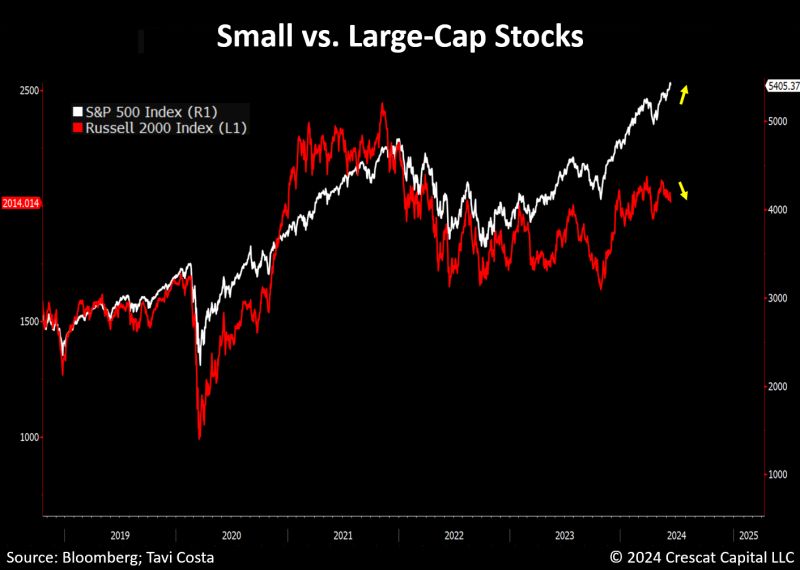
The current gap between small-cap and large-cap stocks does raise some valid concerns about whether they can continue to outperform the rest of the market… or are the large-caps due for a serious correction? Since small-cap stocks are typically more sensitive to economic changes and market sentiment, their underperformance compared to large-cap stocks might indicate that the market is overestimating its strength.
But with so much money floating around, big fund managers have nowhere else to go but large-cap stocks, ie pension fund money can’t speculate in small-cap stocks, so they keep buying up large-cap. For now, it seems like the large-cap stocks are a 1-way directional trade until something serious or a Black Swan breaks the market, which I suspect could happen soon.
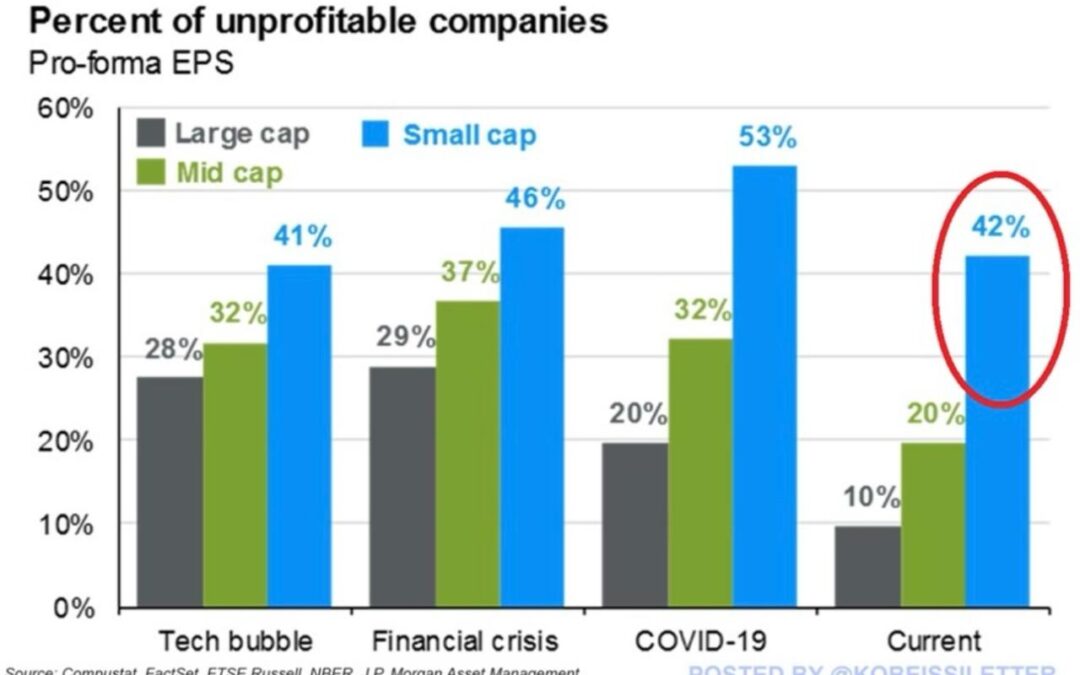
We see that 42% of Small-caps are not profitable, at the same time 10% of S&P 500 and 20% of Mid-cap stocks aren’t profitable. This can explain why the Russell 2000 is not reaching All Time Highs (ATH), it’s trading 21% below ATH because of the elevated interest rates. During the last bubbles, the Tech and Financial crisis had way more unprofitable Large and Mid-cap companies, currently, these are lower than in those times… the small-cap are in line, so this does help explain the current gap between large and small-cap companies and the S&P outperforming.
This coming year will be very volatile and we suspect there could be a Black Swan event at any time and this will send turmoil in the markets, but until that happens, it does look like the S&P will continue to outperform. It is highly doubtful that the small-caps will start outperforming given the high interest rate environment we are currently in and low economic activity by the average consumer. The large-cap’s continuous drive higher could be as simple as there is no other option for big money like pension funds or ETF managers to go to, so they continue to buy up the S&P and the big tech companies in them.
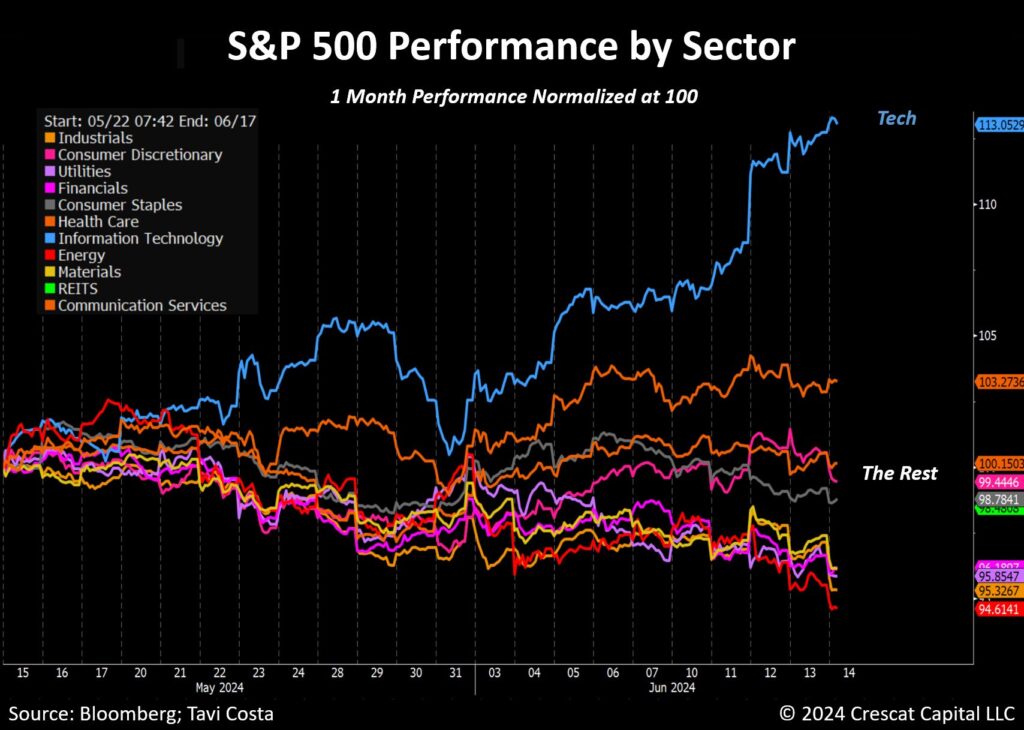
We can clearly see the outperformance in the S&P 500 is from the Infomation Technology sector, the rest just can’t keep up.
So the bull market in the S&P is mostly from a few big-name Tech companies like Nvidia, Apple, Facebook, Google, and a few more.
Without broader participation from all sectors, how long can the S&P Continue to go up???
Monitoring these divergences is crucial, as they can sometimes predict a potential market correction. Persistent struggles in small-cap stocks could suggest that the broader market isn’t as robust as the performance of large-cap stocks might imply.
Although this discrepancy might seem minor now, it’s important to stay aware of these signals to better gauge the market’s overall health and make informed investment decisions. As always, maintaining a well-diversified portfolio that includes both large and small-cap stocks can help mitigate risks during periods of market uncertainty.