The Financial Literacy Gap Between Men and Women

The Financial Literacy Gap Between Men and Women

In today’s fast-paced world, financial literacy is more critical than ever. Yet, there’s a significant gap in financial literacy between men and women. Understanding the reasons behind this gap and how we can bridge it is essential for promoting financial equality and empowerment.

Understanding the Financial Literacy Gap

The financial literacy gap between men and women is influenced by various factors, including societal norms, educational opportunities, and confidence levels. Historically, men have been more likely to be in charge of financial decisions, both in households and in business settings. This trend has contributed to a lingering perception that finance is a male-dominated field. As a result, many women may feel less confident in their financial knowledge and decision-making abilities.

Societal and Cultural Influences

Societal norms and cultural influences play a significant role in shaping attitudes toward money and finance. From a young age, boys and girls often receive different messages about money management. Boys might be encouraged to take risks and learn about investments, while girls might be directed toward saving and budgeting. These early experiences can have long-lasting impacts on financial behavior and confidence.

Educational Opportunities

Educational opportunities also contribute to the financial literacy gap. In many schools, personal finance education is not a mandatory part of the curriculum. When financial education is available, it may not be equally emphasized for both genders. Additionally, women who pursue higher education in fields unrelated to finance may miss out on critical financial literacy skills that are more commonly taught in business and economics programs.

Confidence and Perception

Confidence plays a crucial role in financial literacy. Studies have shown that even when women possess financial knowledge, they may lack confidence in their abilities compared to men. This lack of confidence can deter women from making informed financial decisions or seeking out further education on the topic. Moreover, the financial industry itself can sometimes appear intimidating or unwelcoming to women, reinforcing these confidence issues.

The Importance of Closing the Gap

Closing the financial literacy gap is vital for several reasons. Financial literacy empowers individuals to make informed decisions about their money, investments, and future. For women, increased financial literacy can lead to greater financial independence, security, and the ability to achieve personal and professional goals. It also contributes to overall economic stability and growth, as financially literate individuals are better equipped to manage their resources effectively.

Taking Action: Financial Education for All

One of the most effective ways to bridge the financial literacy gap is through education. Taking a course in basic personal finance can provide valuable knowledge and skills that are essential for managing money wisely. Such courses typically cover topics like budgeting, saving, investing, and understanding credit. They can also help build confidence by providing a solid foundation of financial knowledge.

Investing in financial education benefits everyone, but it is particularly crucial for women who may have been historically underrepresented in financial discussions. By promoting financial literacy education, we can create a more inclusive and equitable financial landscape where everyone has the opportunity to succeed.

In conclusion, the financial literacy gap between men and women is a multifaceted issue rooted in societal norms, educational disparities, and confidence levels. Addressing this gap requires a concerted effort to promote financial education and empower women with the knowledge and confidence to manage their finances effectively. Taking a course in basic personal finance is a practical and impactful step toward achieving this goal, leading to greater financial independence and security for all.


Large-Cap Vs Small-Cap Profits During Bubbles

Large-Cap Vs Small-Cap Profits During Bubbles

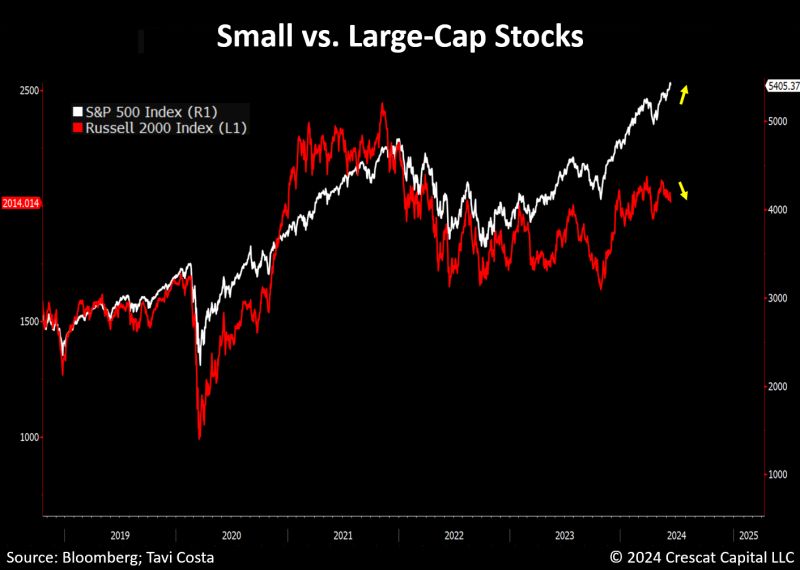
The current gap between small-cap and large-cap stocks does raise some valid concerns about whether they can continue to outperform the rest of the market… or are the large-caps due for a serious correction? Since small-cap stocks are typically more sensitive to economic changes and market sentiment, their underperformance compared to large-cap stocks might indicate that the market is overestimating its strength.

But with so much money floating around, big fund managers have nowhere else to go but large-cap stocks, ie pension fund money can’t speculate in small-cap stocks, so they keep buying up large-cap. For now, it seems like the large-cap stocks are a 1-way directional trade until something serious or a Black Swan breaks the market, which I suspect could happen soon.

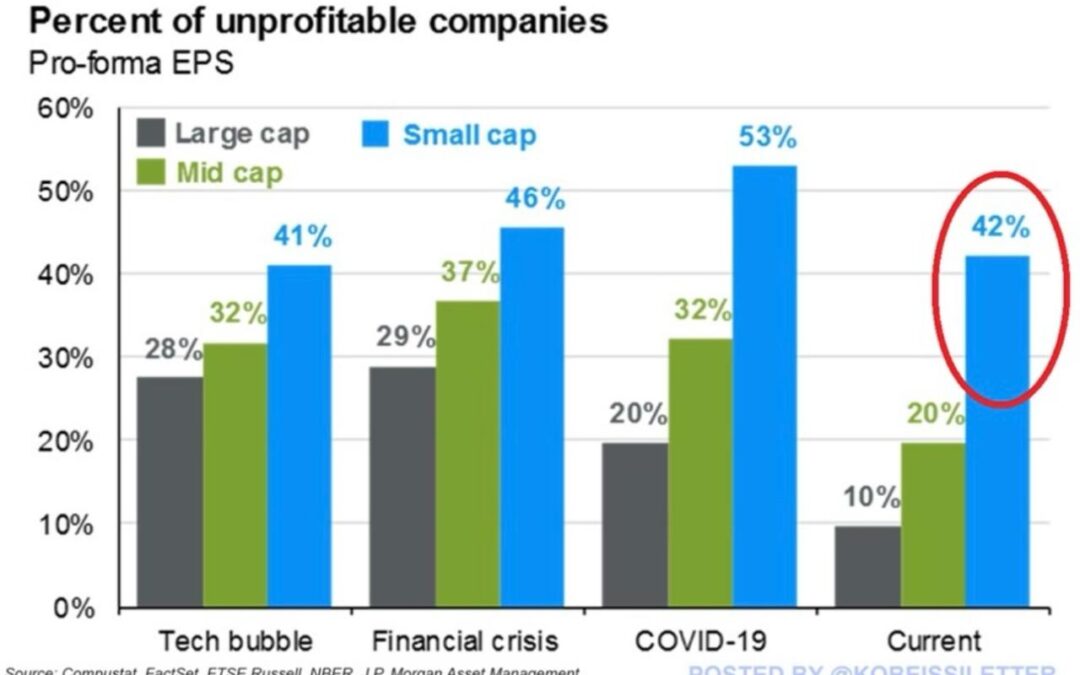
We see that 42% of Small-caps are not profitable,  at the same time 10% of S&P 500 and 20% of Mid-cap stocks aren’t profitable. This can explain why the Russell 2000 is not reaching All Time Highs (ATH),  it’s trading 21% below ATH because of the elevated interest rates.  During the last bubbles, the Tech and Financial crisis had way more unprofitable Large and Mid-cap companies, currently, these are lower than in those times… the small-cap are in line, so this does help explain the current gap between large and small-cap companies and the S&P outperforming.

This coming year will be very volatile and we suspect there could be a Black Swan event at any time and this will send turmoil in the markets, but until that happens, it does look like the S&P will continue to outperform.  It is highly doubtful that the small-caps will start outperforming given the high interest rate environment we are currently in and low economic activity by the average consumer.  The large-cap’s continuous drive higher could be as simple as there is no other option for big money like pension funds or ETF managers to go to, so they continue to buy up the S&P and the big tech companies in them. 

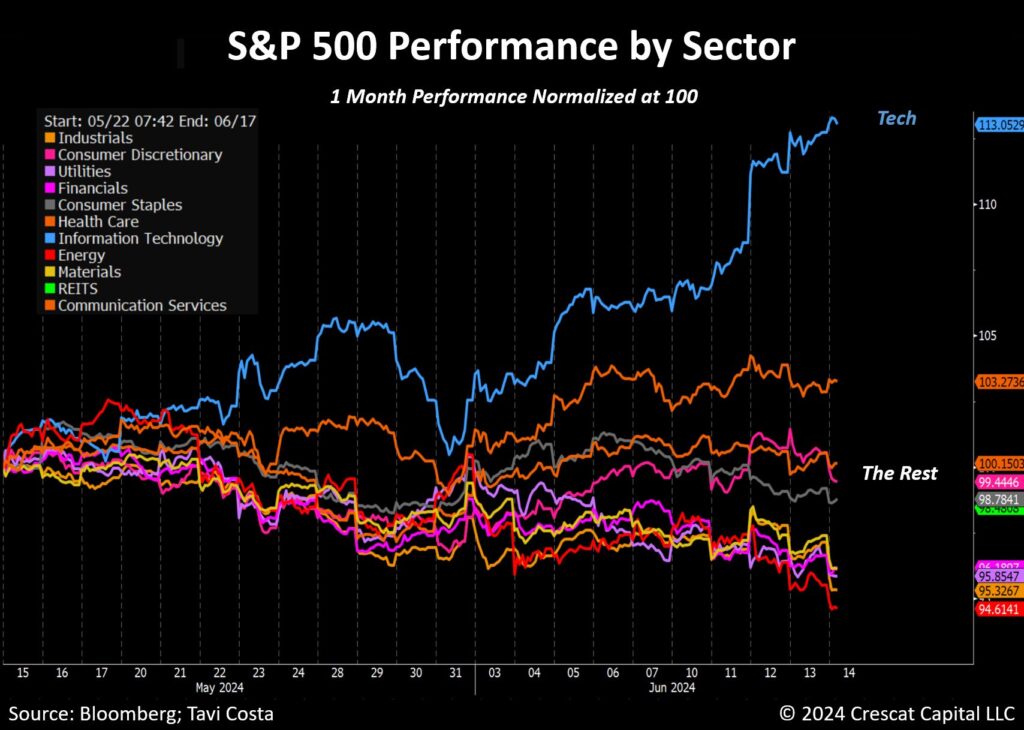
We can clearly see the outperformance in the S&P 500 is from the Infomation Technology sector, the rest just can’t keep up.
So the bull market in the S&P is mostly from a few big-name Tech companies like Nvidia, Apple, Facebook, Google, and a few more.
Without broader participation from all sectors, how long can the S&P Continue to go up???

Monitoring these divergences is crucial, as they can sometimes predict a potential market correction. Persistent struggles in small-cap stocks could suggest that the broader market isn’t as robust as the performance of large-cap stocks might imply.

Although this discrepancy might seem minor now, it’s important to stay aware of these signals to better gauge the market’s overall health and make informed investment decisions. As always, maintaining a well-diversified portfolio that includes both large and small-cap stocks can help mitigate risks during periods of market uncertainty.

Texas Stock Exchange TXSE Coming Soon

Texas Stock Exchange TXSE Coming Soon

The Wild West Of Fintech.

Texas has long embodied a spirit of bold independence and pioneering innovation, rooted in a deep ethos of self-reliance. From its early days as a republic to its contemporary status as a business-friendly powerhouse, the Lone Star State has continuously charted its own course. Reflecting this legacy, a group of enterprising Texan entrepreneurs, led by James Lee and backed by financial heavyweights BlackRock and Citadel Securities, is positioning Dallas and Texas as strategic financial market leaders with the launch of the Texas Stock Exchange (TSXE). Having secured over $100 million in funding from major financial market participants, including BlackRock and Citadel, Lee’s vision is to establish a Texas-based competitor to the NYSE and NASDAQ.

The creation of the Texas Stock Exchange underscores the state’s enduring commitment to innovation and competition, aiming to boost liquidity and transparency in the financial markets while solidifying Texas’ role as a key economic hub.

TSXE To Boost Market Efficiency

A primary objective of the Texas Stock Exchange is to deliver greater liquidity and transparency. By harnessing advanced technologies and data analytics, the TSXE aims to provide more consistent and reliable markets, attracting a diverse array of market participants from institutional investors to retail traders, thereby enhancing overall market depth.

Transparency is crucial in today’s market environment. The TSXE’s strong commitment to transparency seeks to rebuild trust in financial markets, facilitating fairer price discovery and mitigating risks of market manipulation. This ensures a level playing field for all participants.

Why Texas: The Ideal Hub

The decision to base the new exchange in Texas is strategic. The state is renowned for its business-friendly environment and a regulatory framework that encourages innovation and growth. Additionally, Texas’s central location offers logistical advantages, making it an ideal hub for market activities across various U.S. time zones.

The presence of established financial entities such as Fidelity and Schwab in Texas further bolsters the state’s financial ecosystem. These companies can provide valuable synergies and support, aiding in the integration and growth of the new exchange.

TSXE Strategic Advantages

The introduction of the Texas Stock Exchange is poised to benefit the broader financial markets significantly. Increased competition among exchanges can lead to improved services and lower costs for market participants. With BlackRock and Citadel Securities involved, the TSX brings substantial credibility and expertise, which can drive innovation and best practices within the industry.

Moreover, the enhanced liquidity and transparency promised by the TSXE can contribute to more efficient and fair markets. Investors are likely to see better price discovery and reduced risks of market manipulation, creating a healthier trading environment. The TSXE’s commitment to these principles can inspire other exchanges to adopt similar standards, fostering a more robust financial system.

Will the TSXE Overcome Obstacles

Despite promising prospects, the Texas Stock Exchange will face significant challenges. Obtaining regulatory approval from bodies like the SEC will be a critical initial step. The exchange must demonstrate robust compliance frameworks and a commitment to market integrity to gain the trust of regulators and market participants.

Market fragmentation poses another risk. With numerous trading venues available, there is a danger of liquidity being spread too thin, leading to inefficiencies. To avoid this, the new exchange must offer compelling value propositions to attract sufficient volume.

TSXE Future Vision

The Texas Stock Exchange represents a visionary move towards more competitive, transparent, and efficient financial markets. If successful, it could prompt incumbent exchanges to elevate their standards, driving continuous improvement across the industry. For investors, the benefits are clear: enhanced market conditions, potentially lower costs, and innovative trading solutions.

Challenging the dominant NYSE and NASDAQ, the two largest players in the U.S. equities trading market, will be an uphill battle. However, Texas is known for its bold independence and pioneering spirit. The success of the Texas Stock Exchange will depend on navigating regulatory landscapes, building trust, and leveraging the state’s unique strategic advantages. With the support of BlackRock and Citadel Securities, the TSXE is well-positioned to make a significant impact on the financial markets, fostering a more competitive and transparent trading environment.

https://www.reuters.com/markets/us/blackrock-citadel-backed-group-start-new-national-stock-exchange-texas-wsj-2024-06-05/

Can AI Predict The Future Of Stock Markets

Can AI Predict The Future Of Stock Markets

Here’s what ChatGTP and AI think about the future direction of the stock markets…

I decided to ask GTP the following question, and it’s response added no value to determine the direction of the the markets. I have been using it lately, but it can’t predict much about current events and fundamentals for financial markets… that takes real research and analysis.

I am researching more about how AI is used in the financial world of investing, many of the tools available and how it can be used for making investing decisions… I will have a special report about it soon. There are some proprietary tools used by investment firms that incorporate AI usage, so there is value in using AI, but not in asking it’s opinion. Also the world of Finance is about to change dramatically in the next couple of years, Fintech is continuing to evolve and Digital Asset ownership is the future, this is a topic that will be covered in another report.

Do you use AI for making investment decisions? We would love to hear your thoughts below.
 
Question:
Provide a summary of what AI thinks about investing, the future of stock markets, and where the major indexes in the US will head towards in the future. How did you come to these conclusions and what metrics did you use?

ChatGPT Response:
As an AI language model, I don’t possess personal opinions or the ability to predict future events, including the direction of stock markets or major indexes like those in the US. Predicting market movements involves complex factors such as economic indicators, geopolitical events, investor sentiment, and unforeseen developments, which are challenging to model accurately.

However, I can provide insights into how AI and machine learning algorithms are used in investing and what some experts and analysts have speculated about the future of stock markets.


Here’s a summary of common themes:

1. AI in Investing: AI and machine learning have revolutionized investing by enabling data-driven decision-making, automated trading, and advanced analytics. AI algorithms analyze vast amounts of financial data to identify patterns, trends, and anomalies that human analysts may overlook. AI-driven strategies range from quantitative trading and algorithmic trading to sentiment analysis and predictive modeling.


2. Future of Stock Markets: Speculating on the future direction of stock markets involves uncertainty and risk. While historical trends and economic indicators can provide insights, predicting market movements with certainty is challenging. Some analysts and experts anticipate continued market volatility, driven by factors such as geopolitical tensions, interest rate changes, and technological disruptions. Others remain optimistic about long-term market growth, citing factors such as innovation, economic expansion, and corporate profitability.


3. Major Indexes in the US: The performance of major indexes in the US, such as the S&P 500, Dow Jones Industrial Average, and NASDAQ Composite, depends on various factors, including corporate earnings, economic indicators, monetary policy, and investor sentiment. While past performance may provide some indication of future trends, investors should exercise caution and diversify their portfolios to mitigate risks.


Metrics used by analysts and investors to assess market trends and predict future movements include:
– Economic Indicators: GDP growth, unemployment rates, inflation, consumer spending, and manufacturing data.
– Corporate Earnings: Revenue growth, earnings per share (EPS), profit margins, and guidance from companies.
– Market Sentiment: Investor sentiment surveys, consumer confidence indices, and market volatility measures.
– Technical Analysis: Chart patterns, moving averages, relative strength index (RSI), and other technical indicators.

– Fundamental Analysis: Valuation metrics (e.g., price-to-earnings ratio, price-to-book ratio), dividend yields, and qualitative assessments of companies’ competitive advantages and growth prospects.


Ultimately, investing involves inherent risks, and past performance is not indicative of future results. Investors should conduct thorough research, diversify their portfolios, and consider seeking advice from financial professionals before making investment decisions.